Start With the Cracking Result You Need
-
the required degree of cracking;
-
the size and shape of the cracked pieces;
-
oversized or uncracked material;
-
the amount of fines;
-
consistency under similar operating conditions.
How Roll Gap Changes the Cracking Result
-
A larger roll gap tends to produce relatively larger cracked pieces and a lower degree of cracking.
-
A smaller roll gap tends to increase the degree of cracking and produce a higher proportion of smaller pieces. Depending on the material, fines may also increase.

How the Handwheel Roll-Gap Adjustment Mechanism Works
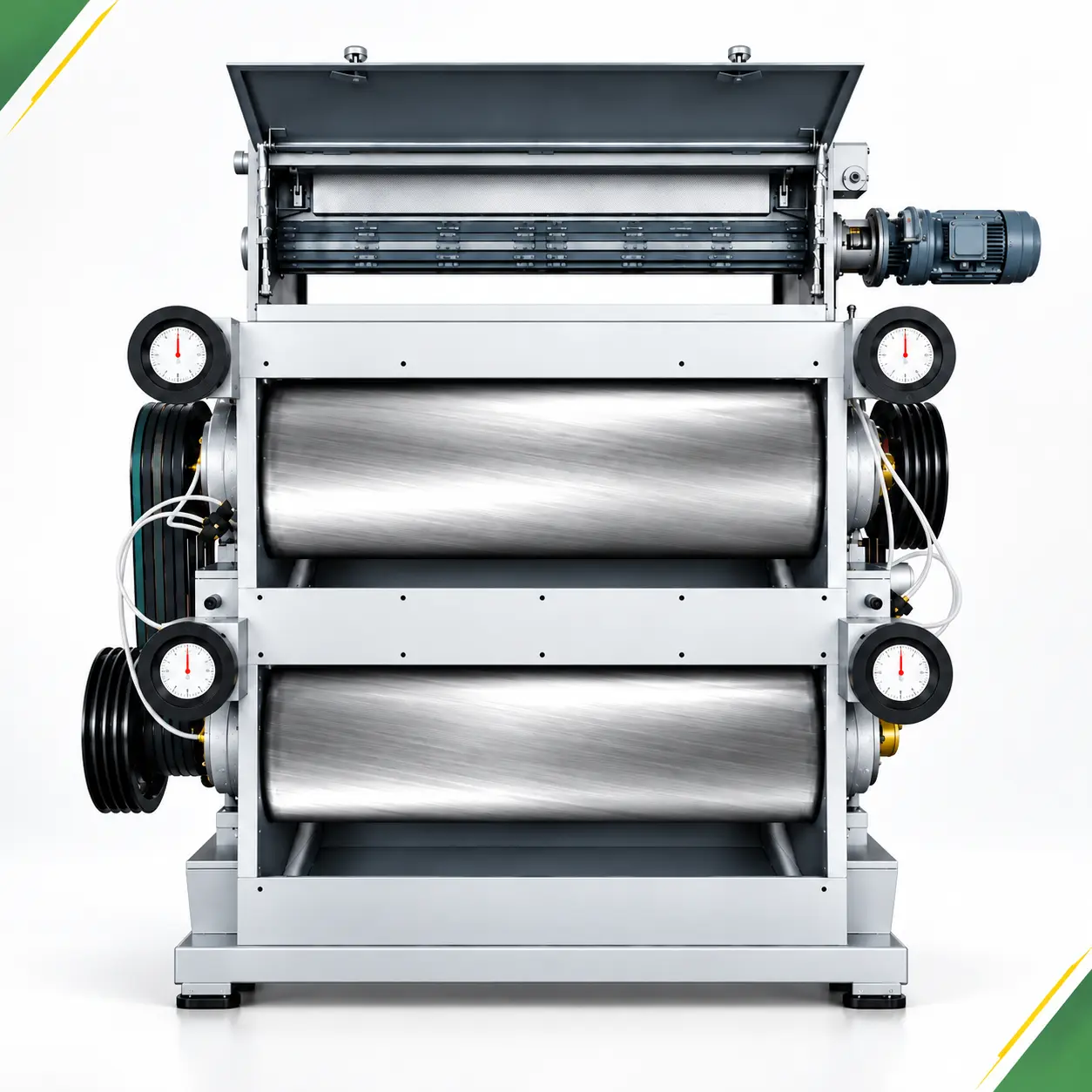
On the Bellaex handwheel-type configuration shown here, turning the handwheel changes the position of the movable roll through the adjustment mechanism.
The movement can be understood as:
Digital handwheel → adjustment shaft → screw mechanism → movable bearing housing → movable roll → roll-gap change
When the handwheel is turned, the adjustment shaft rotates. Through its threaded connection with the fixed screw, this rotational movement is converted into forward or backward movement of the movable bearing housing.
The movable roll moves with it, changing the working gap between the two rolls.

How to Adjust the Roll Gap
For the Bellaex handwheel-type configuration shown in this guide, the roll gap is adjusted through the digital handwheels.
Before shipment, the handwheel scale is set to a zero reference.
At this reference position:
- Upper roll-pair gap: 1.5 mm
- Lower roll-pair gap: 0.75 mm
One full turn of the handwheel moves the roll forward or backward by approximately 0.8 mm.
These values help you understand the relationship between handwheel movement and mechanical displacement. The final setting still needs to be judged from the actual cracked material.
Make roll-gap adjustments only when the machine is stopped.
Before comparing the results from two settings, keep the material and feeding conditions as consistent as practical. Otherwise, it becomes difficult to tell whether a change in the output came from the roll-gap adjustment or from the feed condition.
If feeding is surging, intermittent, bridging, or otherwise unstable, check the feeding condition before comparing the settings.
Step 1 — Release the Locking Handle
Turn the locking handle counterclockwise to release the handwheel before adjustment.
Step 2 — Adjust the Roll Gap
Turn the digital handwheel to move the adjustable roll forward or backward and change the distance between the rolls.
Step 3 — Keep Both Sides Consistent
When adjusting the same roll pair, turn the handwheels on both sides by the same number of revolutions.
This helps keep the gap consistent across both ends of the roll rather than leaving one side wider than the other.
Step 4 — Lock the Setting
Once the adjustment has been made, tighten the locking handle clockwise to secure the setting.
Then check the actual cracking result before deciding whether another adjustment is needed.

See the Adjustment in Operation
The video below shows the actual roll-gap adjustment procedure on the handwheel-type configuration, including the locking handle, digital handwheel, and adjustment on both sides of the roll.
[Video — How to Adjust a Cracking Mill Roll Gap]
How Do You Know Whether the Roll-Gap Setting Is Right?
After the adjustment, the most useful question is not:“How many turns did I make on the handwheel?”
It is:“Is the cracked material now giving me the result I need?”
Use the actual output to judge the setting.
1.Is the Degree of Cracking Close to the Target?
Start with the overall result.
Is the material still obviously too coarse, or is it now close to the degree of cracking required by the downstream process?
2.Are There Too Many Oversized or Uncracked Pieces?
If too much material remains uncracked or excessively large, the current degree of cracking may still be insufficient.
Do not change the gap based on this observation alone. Feeding conditions and roll condition should also be considered.
3.Are Fines Becoming Excessive?
Increasing the degree of cracking can also increase the amount of smaller particles and fines.
If reducing oversized pieces creates more fines than the downstream process can tolerate, the setting may no longer be suitable.
4.Is the Result Consistent Under Similar Conditions?
A single good-looking sample does not necessarily mean that the operating condition is stable.
Under broadly similar material and operating conditions, check whether the output remains reasonably consistent.
5.Is the Material Suitable for the Next Processing Step?
Most importantly, is the cracked material suitable for the process that comes next?
A gap number may look reasonable on paper, but if the actual output does not meet the needs of the downstream process, it is not the right setting for that application.
If the result is still not satisfactory, work back through the main conditions:
Target Result → Material & Feeding → Roll Gap → Roll Condition → Actual Output
Then decide what to adjust next based on what you actually see.
For routine comparisons, collected samples and photographs can help show relative changes between settings.
If a project has a formal numerical requirement for particle size, fines, or another output characteristic, it should be evaluated using an agreed method rather than visual appearance alone.

If the Result Still Looks Wrong, Check the Roll Condition
If the material and feeding conditions are broadly unchanged but the cracking result starts to change, also check:
- tooth condition;
- roll wear;
- gap consistency from one side of the roll to the other.
Changes in the roll surface can affect how the material is gripped and cracked. An uneven gap across the roll can also create different cracking conditions across the working width.
A Real Example: C25125G Corn Cracking Trial
Bellaex has documented a short-duration corn cracking trial using a C25125G Cracking Mill, with actual samples retained from different recorded test conditions.
The samples provide a visual reference for how the observed cracking result can change under different settings and test conditions.
The trial records should be read within their actual test conditions. The samples are useful for visual comparison, but they should not be treated as:
- a universal particle-size standard for corn;
- a result that automatically applies to other materials;
- proof that one fixed roll gap always produces one fixed particle size;
- evidence of continuous-production capacity.

View the Full C25125G Corn Cracking Trial
Related equipment: C-Series Cracking Mill
Need Help Evaluating Your Target Cracking Result?
If your material, operating condition, or target result does not have a close existing reference, send Bellaex the basic application information:
- material;
- target cracking result;
- downstream process;
- material condition;
- existing equipment or retrofit conditions, where relevant.
Bellaex can first review these details and determine whether the next step should be a setting recommendation, further technical evaluation, or a material trial.
If a trial is useful, the actual material can then be evaluated under recorded test conditions rather than relying only on a nominal gap number.