
Many dairy farms and beef feedlots include corn in their cattle diets to provide energy for milk production and weight gain. In practice, some farms use ground corn, while others use steam-flaked corn.
So, what is the difference between these two processing methods? And which one can bring greater value to your livestock or feed business?
Both grinding and steam flaking can improve how cattle utilize corn, but they work in different ways.
What Is the Difference Between Steam-Flaked Corn and Ground Corn?
The most obvious difference is the appearance of the finished product.
Ground corn comes in coarse particles, fine particles, or powder, depending on the grinder, screen size, and other processing conditions. Steam-flaked corn is treated with moisture and steam before being pressed into thin flakes by rollers.

But the more important difference is what happens inside the corn kernel.
|
Comparison |
Ground Corn |
Steam-Flaked Corn |
|
Processing method |
Mechanical grinding reduces particle size |
Combines moisture, steam conditioning, and roller flaking |
|
Finished product |
Coarse particles, fine particles, or powder |
Flattened corn flakes |
|
Changes to starch structure |
Mainly increases starch exposure by reducing particle size |
Heat, moisture, and rolling change starch and its surrounding structure |
|
Starch utilization |
Closely related to particle size and other grinding conditions |
Influenced by both conditioning and the degree of flaking |
Inside a corn kernel, starch granules are closely surrounded by proteins and other structures. Grinding breaks the kernel into smaller pieces, but steam flaking adds an important step: the corn is treated with moisture and steam before being pressed between rollers.
This process changes the starch structure and disrupts part of the protein matrix surrounding the starch granules, making it easier for microbes and digestive enzymes in the animal's digestive tract to reach the starch.
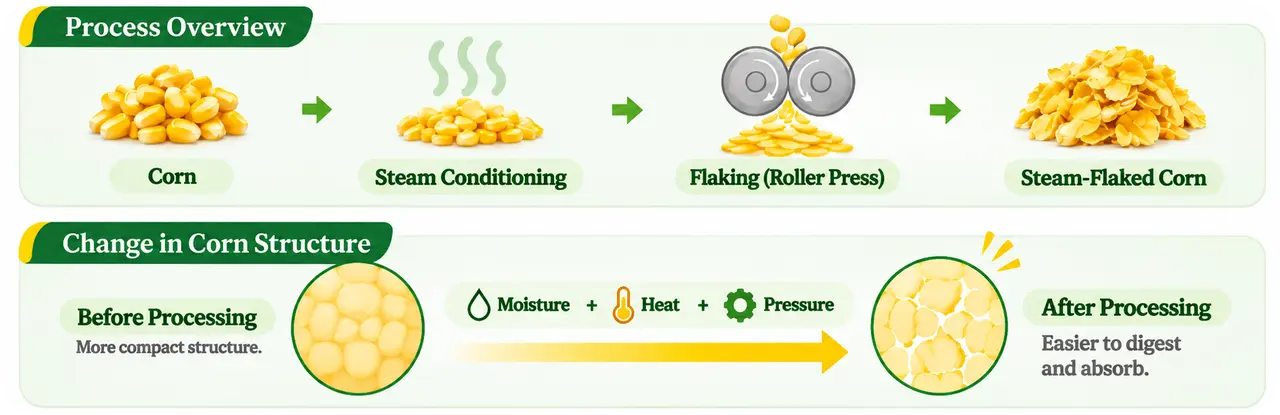
A 2002 review published in the Journal of Animal Science also emphasized that breaking down the protein matrix around starch granules is one important mechanism for improving corn starch digestion.
The difference between steam flaking and grinding goes beyond turning kernels into thin flakes. Through heat, moisture, and rolling, steam flaking changes the internal structure of corn itself, creating different conditions for starch digestion and utilization.
What Advantages Has Research Found for Steam-Flaked Corn Compared with Ground Corn?
Differences in processing methods ultimately need to be tested in actual cattle-feeding studies.
Researchers have directly compared steam-flaked corn with corn ground to different particle sizes. The findings worth looking at include starch digestibility, feed efficiency, and animal growth performance.
Compared with Coarsely Ground Corn: Better Weight Gain and Feed Efficiency in a Feeding Trial
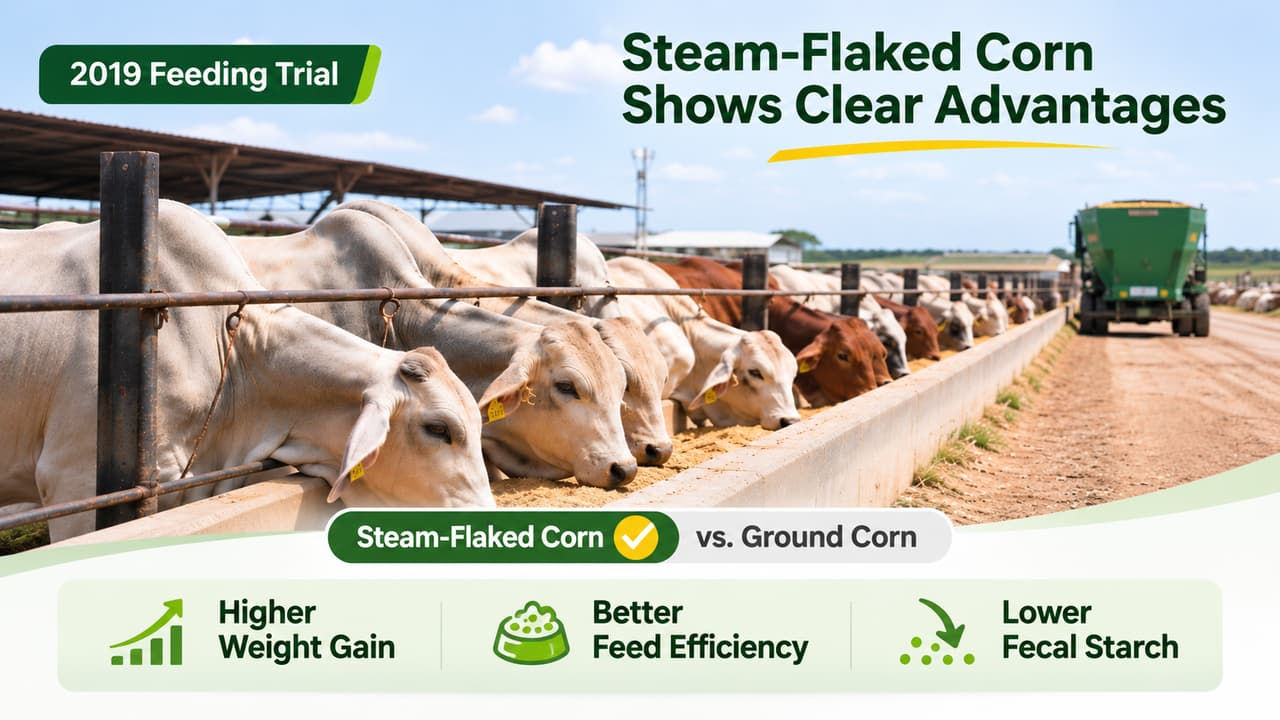
A 2019 study published in the Journal of Animal Science compared coarsely ground corn and steam-flaked corn in 240 Nellore finishing bulls fed diets with different roughage levels.
The study used flint corn. The coarsely ground corn had an average particle size of 3.2 mm, while the steam-flaked corn had a flake density of 0.360 kg/L.
The researchers observed the following results:
|
Research Indicator |
Steam-Flaked Corn vs. Coarsely Ground Corn |
|
Carcass-adjusted average daily gain |
10.6% higher |
|
Carcass-adjusted feed efficiency |
19% higher |
|
Fecal starch concentration |
Lower |
In this direct comparison, cattle fed steam-flaked corn showed higher carcass-adjusted weight gain and feed efficiency, as well as less starch remaining in their feces.
Fecal starch concentration is a particularly useful indicator here. A lower fecal starch concentration means less undigested starch was excreted, which is consistent with the explanation that the cattle made more complete use of corn starch.
Compared with More Finely Ground Corn: Further Potential to Improve Starch Digestibility
Some producers grind corn more finely to expose more starch. Even setting aside the feed waste and dust that finer grinding can cause, how does it compare with steam-flaked corn?
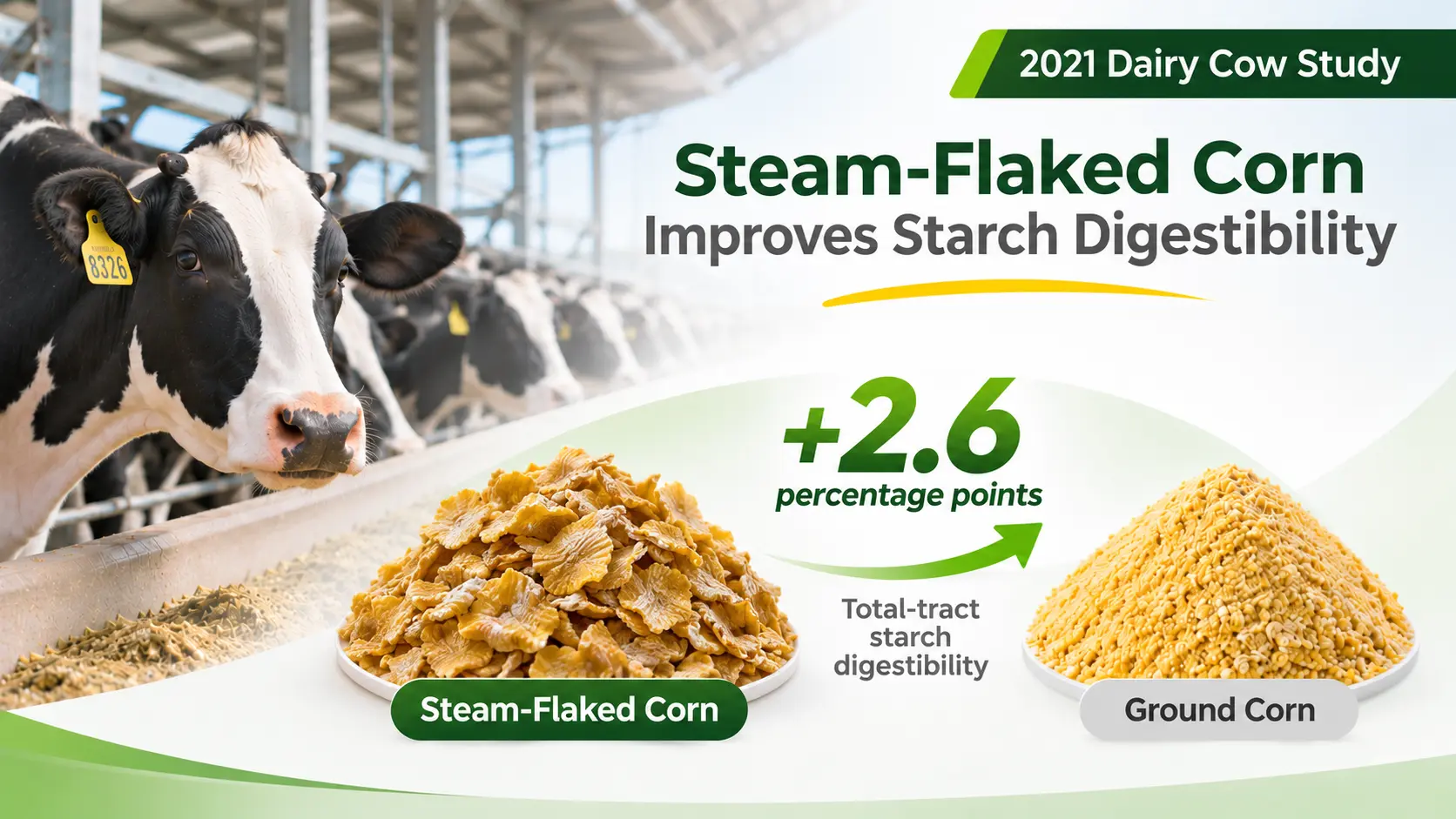
A 2021 study published in the Journal of Dairy Science evaluated 24 lactating Holstein cows fed diets containing corn processed in different ways, including ground corn and steam-flaked corn.
The researchers measured the following total-tract starch digestibility:
| Corn Processing Method | Total-Tract Starch Digestibility |
| Ground corn | 92.50% |
| Steam-flaked corn | 95.10% |
In this trial, the steam-flaked corn group showed 2.6 percentage points higher starch digestibility than the ground corn group.
A separate 2021 meta-analysis published in Animal Feed Science and Technology specifically examined the effects of replacing finely ground corn with steam-flaked corn in dairy cow diets. The combined results also showed higher starch digestibility with steam-flaked corn.
These studies show that steam flaking can further improve starch utilization through heat, moisture, and roller processing, even when finely ground corn already provides good conditions for starch digestion.
These comparisons show that the advantages of steam flaking go beyond the processing method itself. Under the feeding conditions studied, they were reflected in measurable differences in starch utilization and animal performance.
Why Does Steam-Flaked Corn Processing Quality Matter?
The research above shows the valuable results steam flaking can achieve.
But producing steam-flaked corn involves more than simply passing kernels between rollers and flattening them into flakes.
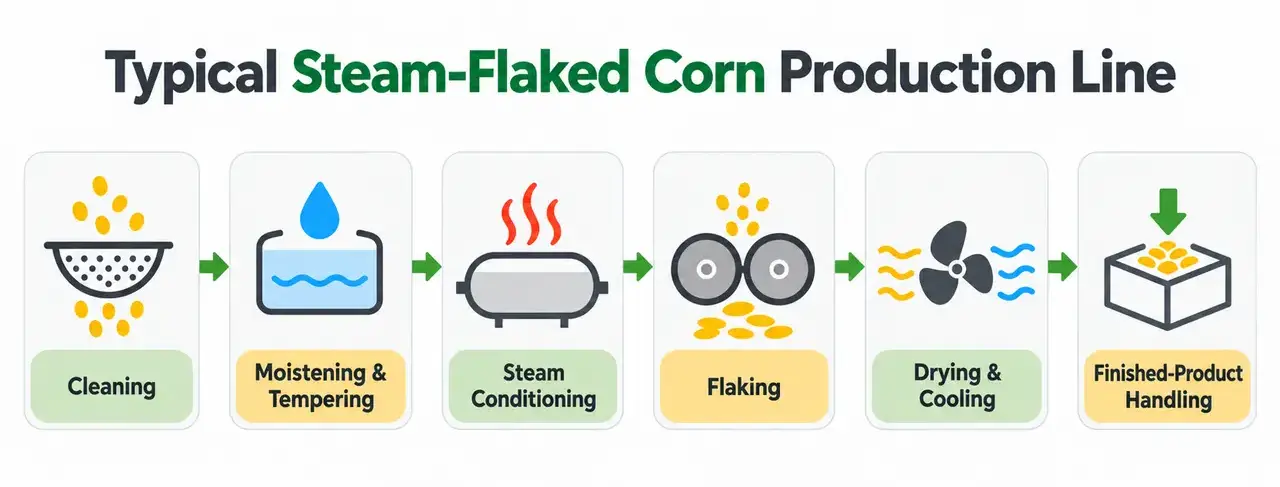
From raw material preparation to the finished product, moisture, steam conditioning, and roller flaking need to work together.
For example, steam conditioning affects the moisture and temperature of the corn before it enters the flaking mill. Roll gap, material distribution, and the degree of flaking then affect the shape and processing characteristics of the finished flakes.
A 2016 survey of 17 commercial feedlots and 49 steam-flaking mills in the United States found considerable variation in laboratory-measured enzymatic starch availability under different processing conditions.
The key to steam-flaking production is to coordinate raw material preparation, steam conditioning, roller flaking, and finished-product quality control into one integrated process.
For feed mills and grain processors that want to produce steam-flaked corn consistently, coordinating the entire production line is just as important as choosing the right equipment.
Explore Bellaex Steam-Flaked Corn Production Solutions
With 29 years of experience in the feed-processing industry, Bellaex provides one-stop turnkey production-line solutions and steam-flaking equipment for corn. Our solutions cover raw material cleaning, moisture preparation, steam conditioning, flaking, and project-specific drying, cooling, and finished-product handling.
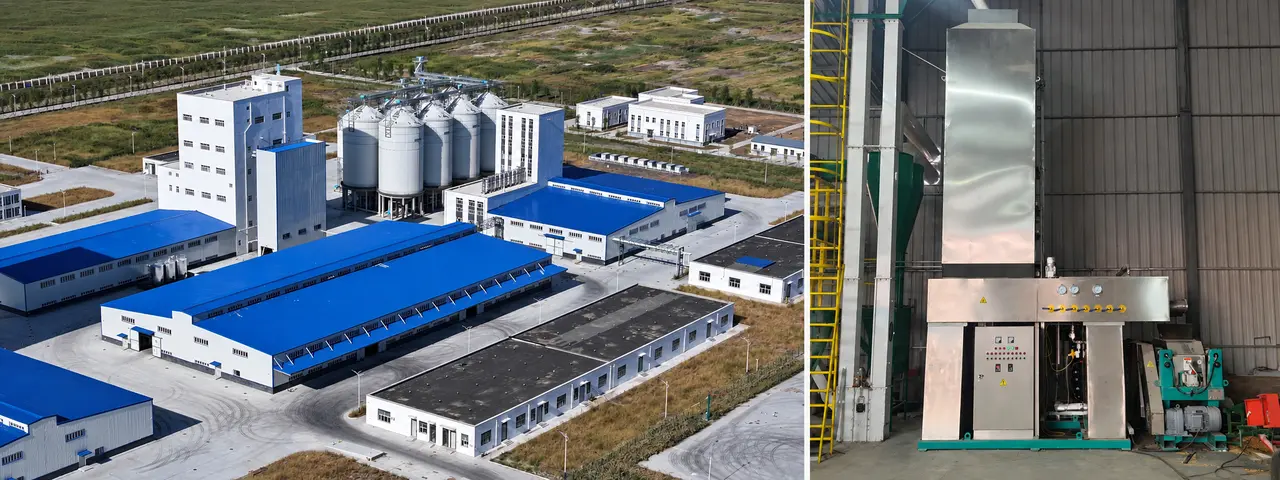
If you are planning a new steam-flaked corn production line or looking to add steam flaking to an existing facility, we can discuss suitable processes and equipment configurations together, based on your corn, finished-product requirements, production capacity, and site conditions.
Explore our Bellaex Steam-Flaked Corn Production Line, or contact us to discuss your project.


